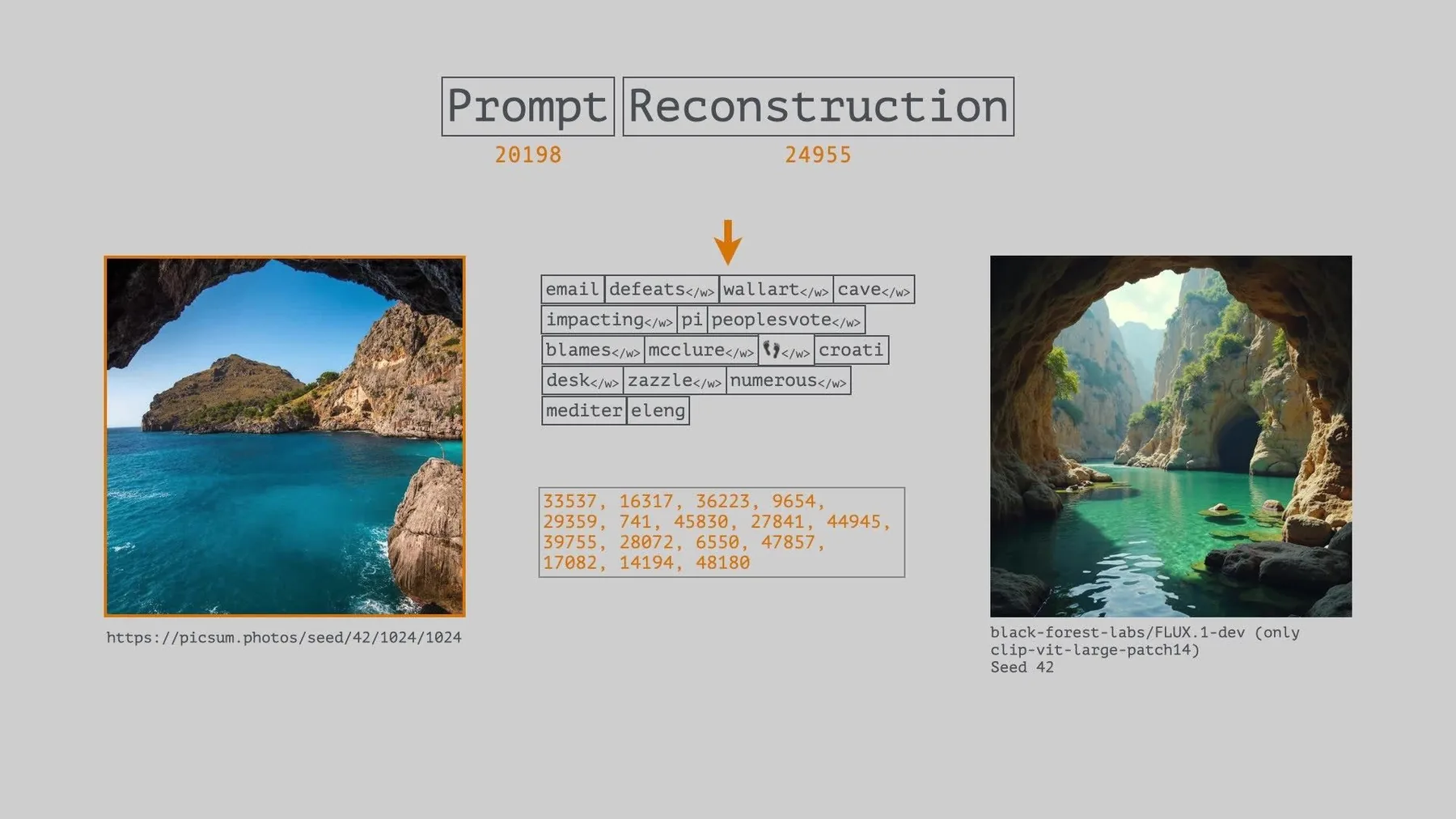
email, defeats, wallart, cave, impacting, pi, peoplesvote, blames, mcclure, 👣, croati, desk, zazzle, numerous, mediter, eleng
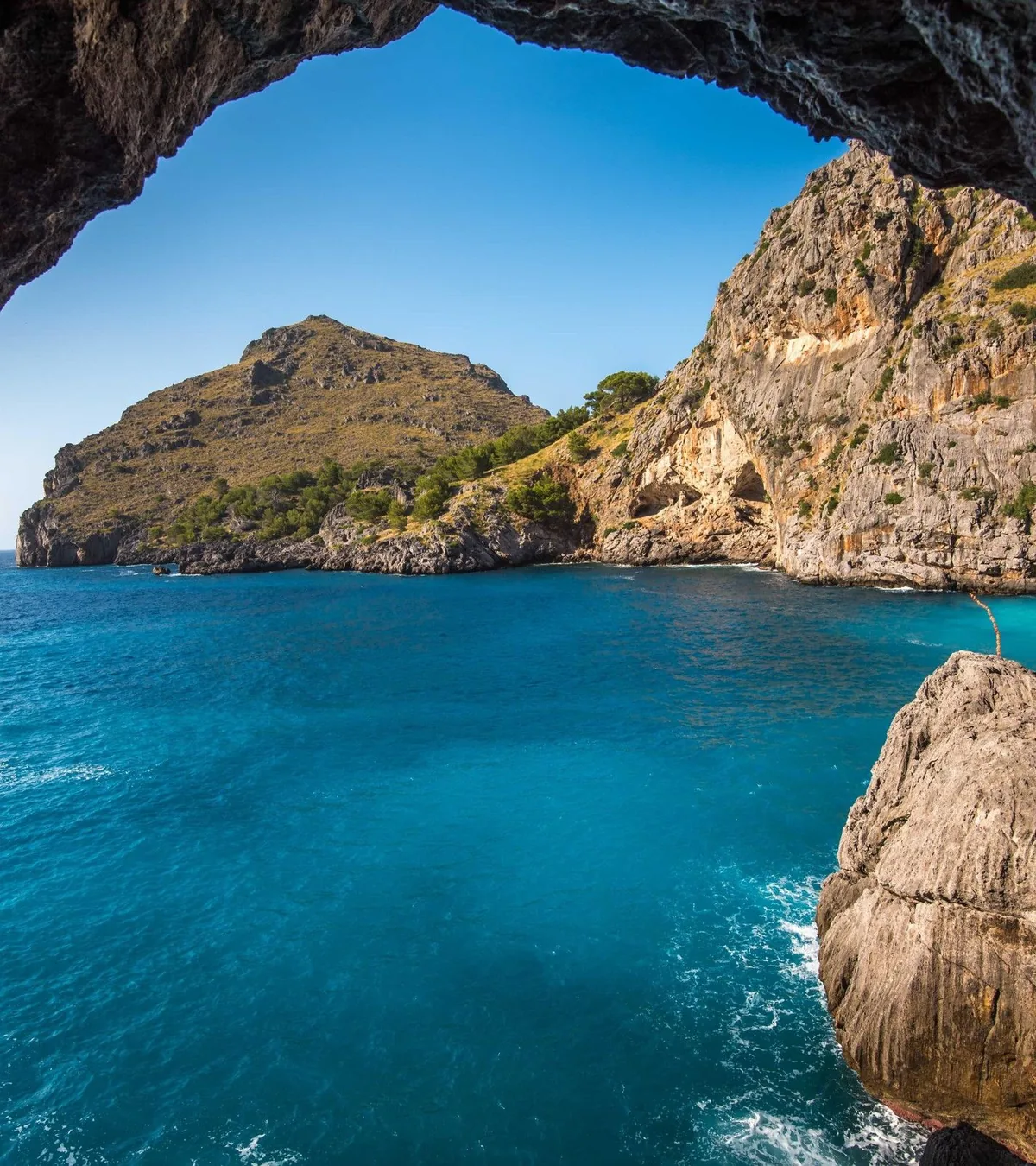
These sixteen tokens describe a photograph of a sea cave. They were written for a machine, and no person chose them. Captions cannot exhaust a picture, and images often escape the tongue; there is no correct description to arrive at in either direction.
The machine is CLIP, a multimodal foundation model that many image generators use to link pictures and words. A Vision Transformer turns the photograph into a vector, a text transformer does the same with a sequence of tokens, and the closer the two point in the same direction, the higher the score. CLIP's dictionary of about 49,000 tokens is at once its vocabulary and its measure of how well a sentence fits an image.
A genetic algorithm
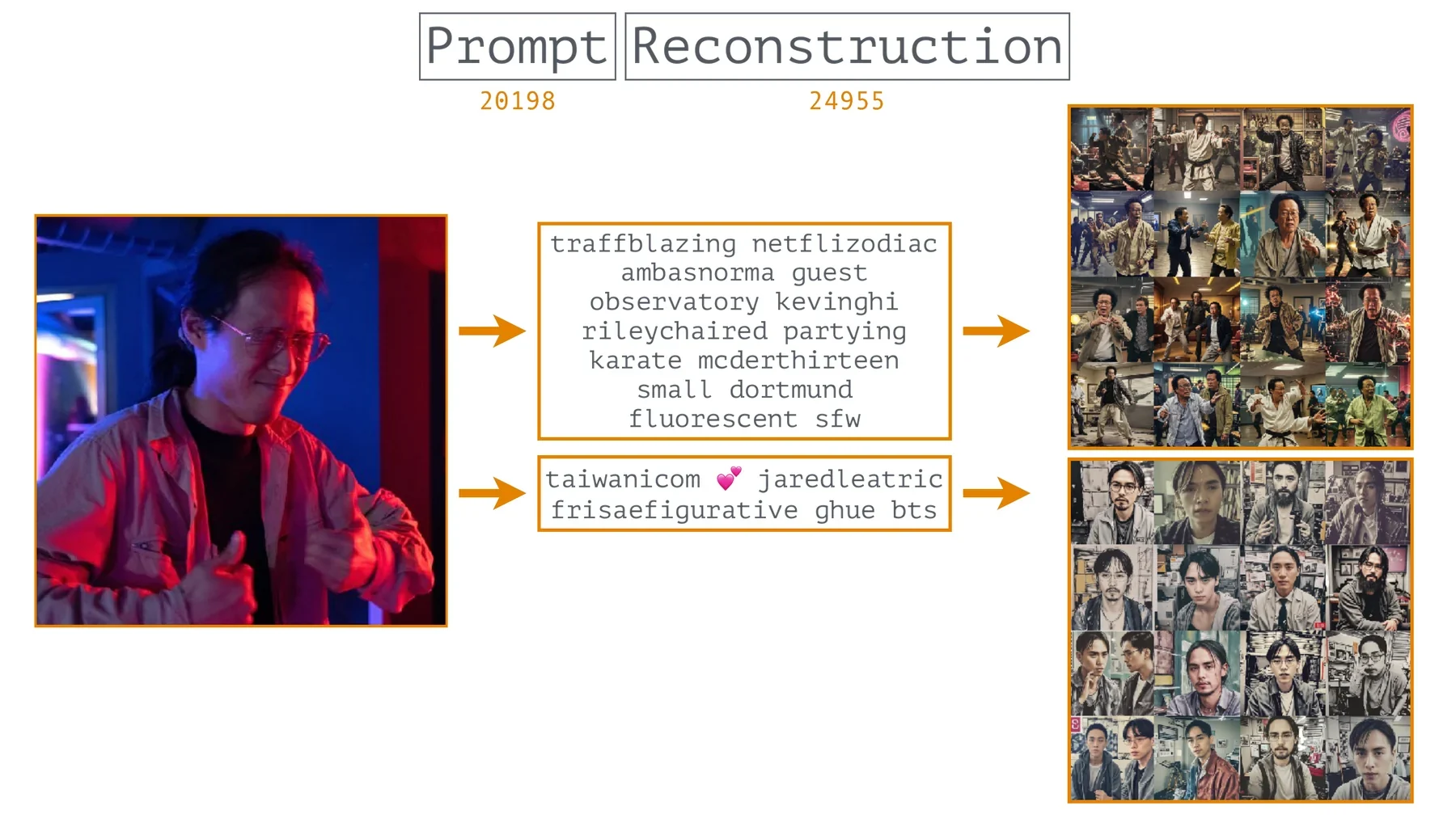
The sequence was bred, not written. A genetic algorithm imitates evolution: it starts with a population of random token sequences, scores each one against the photograph, keeps the best, and breeds the next generation from them, crossing two sequences over and mutating single tokens at random. Over two hundred generations, with 2048 candidates each, the sequences crept closer to the image and settled on a local optimum: one of many possible answers, not the right one. One image yields many sequences, and each sequence yields many images.
The result reads like noise: half-words such as croati and mediter, a shop name, a political hashtag, footprints. Yet image models that took no part in the search draw a cave from it. The tokens are handed to each model as numbers, skipping the step in which written text would be cut into tokens, so the poem exists only in the machine's own vocabulary.
The work reads such sequences as poetry for machines, adversarial in two directions: to the model, which was built for natural language and is optimised here only against its own score; and to the human reader, as writing that resists paraphrase. We are not the ones addressed; we only overhear.
The same prompt, four models
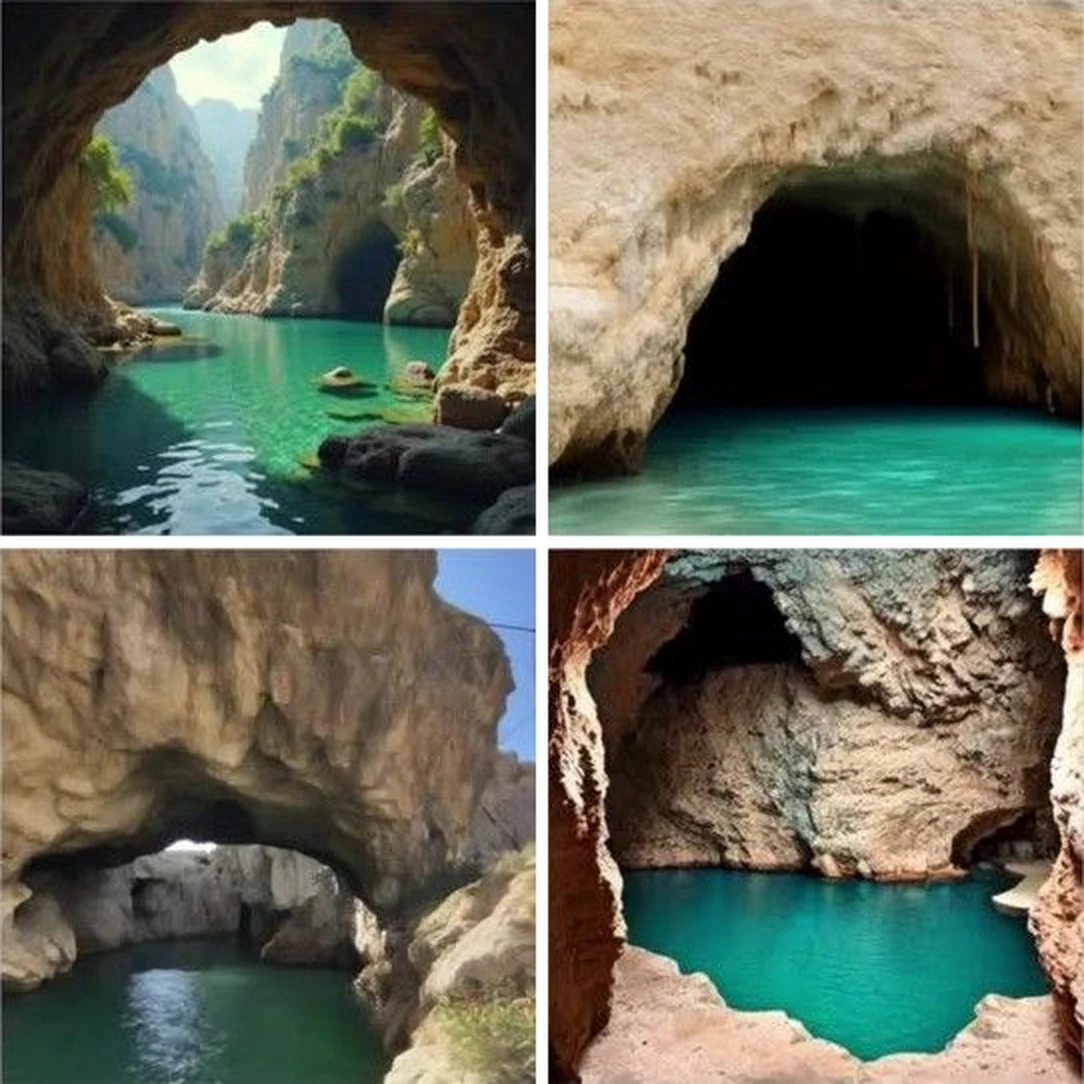
The actual prompt is nothing but these sixteen numbers, one per token: 33537, 16317, 36223, 9654, 29359, 741, 45830, 27841, 44945, 39755, 28072, 6550, 47857, 17082, 14194, 48180. The same sixteen numbers were given to four image generators, none of which took part in the search, and each drew its own sea cave: FLUX.1-dev and Stable Diffusion 3.5 Medium (both reading only their CLIP ViT-L/14 text encoder), Stable Diffusion XL Base 1.0 and Stable Diffusion 1.5. Put simply: a list of numbers that means nothing to a person still brings back the picture in different machines.
Closer than words
How close CLIP finds the photograph and five descriptions of it:
(lazy) human, “a photo of a cave and the ocean”: 0.272
the sixteen tokens: 0.433
ChatGPT: 0.258
JoyCaption Beta One: 0.271
Gemini: 0.273
The tokens score highest because this score is exactly what the search pushed up. What counts is that other image models, which never saw the search, still read them as a cave.
Prompt reconstruction
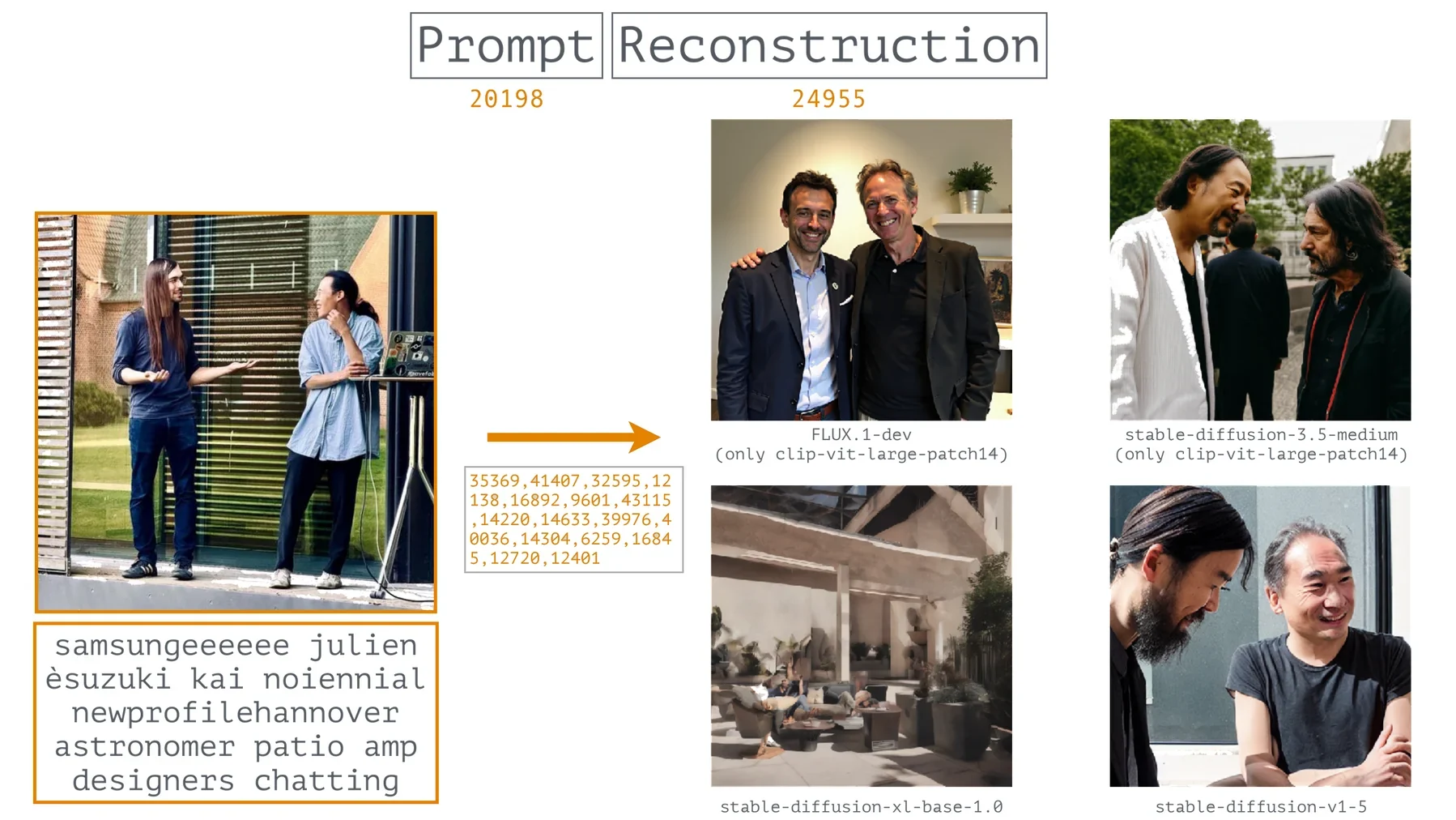
The same method works on photographs of people. Bred from a snapshot of two people talking outside, “samsungeeeee julien èsuzuki kai noiennial newprofilehannover astronomer patio amp designers chatting” makes FLUX.1-dev, Stable Diffusion 3.5, SDXL and Stable Diffusion 1.5 each draw their own version of two people in conversation.
Status
In development. A first version was shown as “Prompt Reconstruction” in the talk 51 Ways to Spell the Image Giraffe (39C3, Hamburg, 2025).
Artists and developers: Ting-Chun Liu, Leon-Etienne Kühr
Target photograph: Stefan Kunze / Unsplash
Four-image grid, row by row: FLUX.1-dev, Stable Diffusion 3.5 medium, Stable Diffusion XL, Stable Diffusion 1.5